Best Way to Develop Combat Instincts That Actually Work
Combat instincts develop through deliberate, progressive training that exposes your mind and body to increasing levels of challenge and resistance. If you’re interested in developing the reflexes and decision-making skills that come from structured combat training, you need a system that combines high-intensity sparring with consistent practice and injury prevention.
The SEVEN Positional Goals | Fudoshin Kenpo Jujitsu
Developing combat instincts follows a learnable path. You need a clear framework, consistent training frequency, and the discipline to progress gradually. Here’s how to approach it.
Related: Real World Combat Training Methods That Actually Work
Related: Practical Self-Preservation Martial Art Methods That Actually Work
Related: Best Defense Control Techniques That Actually Work
Start with High-Paced Training Against Resistant Opponents
Combat instincts develop through sparring against opponents who provide genuine resistance. Drilling techniques against compliant partners teaches you the mechanics, but live resistance exposes your nervous system to real-time adaptation and decision-making under pressure.
Increase your sparring frequency gradually. Start with controlled-intensity rolling and light sparring against experienced training partners. As your confidence and conditioning improve, gradually increase the difficulty of your opponents. This progressive exposure builds your capacity to handle increasing challenge levels.
Dynamic combat sports like wrestling and sambo are effective for developing these skills because they demand constant adaptation. Your opponent is always moving, always resisting, and you’re forced to stay responsive. That’s where practical combat sense develops.
When you’re ready to deepen your foundation, the Fudoshin Kenpo Jujitsu system offers structured methodologies that blend American Kenpo striking with Jujitsu grappling, designed to build practical combat skills in both standing and ground fighting scenarios.
Build the Physical Foundation: Speed, Power, and Conditioning
Combat skills operate through your body. Without the physical tools, your mind can’t execute what it knows. You need speed to close distance and capitalize on openings. You need power to make techniques work under pressure. You need combat-specific conditioning so you can maintain sharp decision-making throughout extended training sessions.
Speed work includes footwork drills, hand and foot combinations, and reaction-based exercises that train your neuromuscular system. Power develops through resistance training tailored to combat demands: explosive movements that translate directly to striking and grappling, not isolation exercises.
Conditioning for combat training trains your cardiovascular system under the specific stress patterns of fighting: short, intense bursts followed by brief recovery, repeated for rounds. Your body adapts to this rhythm, and your decision-making capacity develops alongside your physical conditioning.
Develop Mental Resilience Through Progressive Challenge
Effective combat performance comes from psychological resilience. You build it by training through challenging situations, by deliberately putting yourself in progressively difficult scenarios, and by staying composed when pressure increases.
This means sparring when you’re fatigued. It means rolling against opponents who are stronger or more experienced. It means training your mind to stay focused and tactical even when your body is under stress. Every time you execute a technique under challenging conditions, you develop greater familiarity with performing under pressure.
Consistent training at appropriate intensity levels is essential. This isn’t about reckless intensity that causes injury. It’s about finding the edge between challenge and sustainability, training hard enough to stimulate adaptation, and smart enough to recover and continue training.
Implement Injury Prevention to Support Long-Term Training
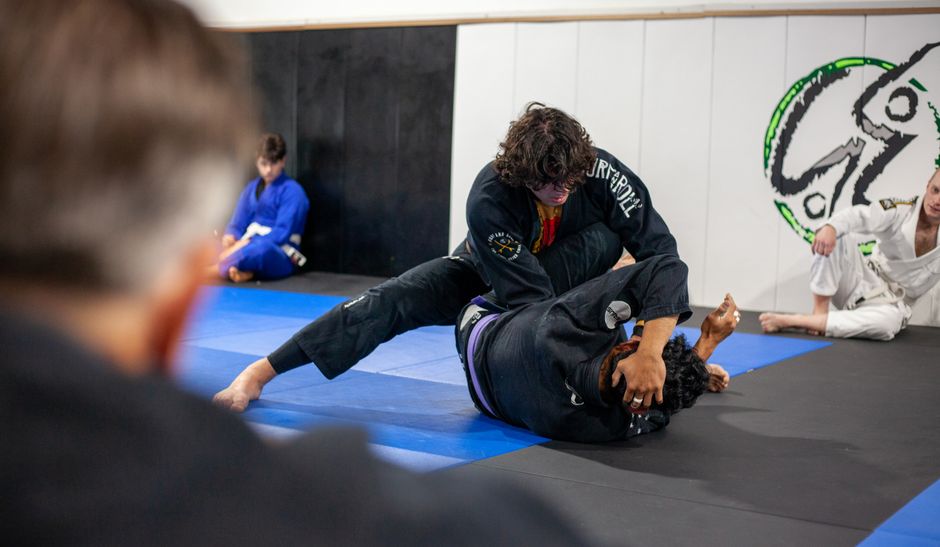
You can’t develop combat skills if you’re unable to train. Injury prevention is essential for consistent training.
- Warm up thoroughly before every session, emphasizing joint mobility and movement patterns you’ll use in sparring
- Use proper technique during drilling so your nervous system learns correct movement patterns
- Communicate with training partners during sparring about intensity levels and stop when something feels wrong
- Balance higher-intensity training weeks with lower-intensity weeks where training continues
- Prioritize sleep and nutrition so your body can recover between sessions
The goal is consistent training over months and years. Combat skills develop through thousands of repetitions across hundreds of hours. You need a training approach that keeps you healthy enough to show up week after week.
Progress Your Opponent Difficulty Strategically
You learn faster when you’re slightly outside your current skill level, training against opponents who present appropriate challenge. That’s where adaptation happens.
Build a rotation of training partners at different skill levels. Train with people slightly ahead of you so you’re constantly being challenged. Train with people at your level and slightly below so you can practice executing techniques. Occasionally train with significantly more experienced opponents so you see what advanced-level performance looks like.
This graduated exposure keeps your nervous system engaged with appropriate levels of challenge. You’re always learning but not overwhelmed. Over time, what felt difficult becomes more familiar.
Use a Proven Martial Arts System as Your Framework
Structured training builds skills more reliably than random training. US Kenpo Jujitsu provides a coherent framework: a methodology that integrates striking mechanics, grappling principles, and the philosophical discipline of Bushido to create a complete combat system grounded in practical application.

When you train under a coherent system, every technique builds on the previous ones. Every principle reinforces the others. Your training develops a logical structure instead of a disconnected collection of moves. That structure becomes the foundation of practical combat skill.
The system also emphasizes the mental and philosophical dimensions of combat training. Developing practical skills isn’t just physical. It’s about cultivating the mental focus, the decisiveness, and the character that support performance under pressure.
How long does it take to develop practical combat skills?
Can you develop combat skills without sparring?
Drilling and technical training build muscle memory and understanding. However, live resistance provides exposure to real-time interaction with an opponent. Sparring is an important component of most combat training systems for developing practical application skills. Consult your instructor or training program for guidance on how sparring fits into your training approach.
What’s the difference between combat skills and just being aggressive?
Effective combat performance combines tactical awareness, decision-making, and technical execution under pressure. You’re not just attacking. You’re seeing openings, timing your entries, adapting when your opponent responds, and maintaining focus while operating at high intensity. That comes from trained exposure to resistance and challenge, not from attitude alone.
Should I train multiple martial arts to develop better skills?
A unified approach that integrates multiple skill sets within a coherent framework, like the Fudoshin Kenpo Jujitsu method that combines striking and grappling principles, provides structured progression. Consistent, focused training in one complete system builds familiarity with integrated patterns. Refer to your instructor or training program for guidance on how to structure your training.
US Kenpo Jujitsu Quick Facts
- Founder: Brian K Allen
Martial Art and Self Preservation System Designed For Military, Law Enforcement, Corrections, and Reality Based Folks
Fudoshin Kenpo Jujitsu is a martial art and self-defense system that emphasizes a balance between stand-up fighting and ground fighting. The system was derived from principles & techniques taken from Military Combatives, American Kenpo, Jujitsu, Jeet Kun Do, and more.
It’s a system that focuses first on the primal instinctive reactions of human beings under duress, and is then followed by scientific principles of techniques.
Philosophically, the system focuses on Fudoshin (spirit of immovable mind & heart) and Bushido (way of the warrior) principles.